Saturday, June 12, 2010

Blossom Valley Scholastic Summer Camp: Math and Science


Registration is open!!
Scholastic Summer Camp - Math and Science
Blossom Valley
Is your 4th, 5th or 6th grader struggling with enjoying math, or do they simply love it?
Concepts: Number Sense, Fractions, Pre-Algebra, Geometry, Graphing, and more!

 This summer we will take concepts from boring textbooks, state standards and the SAT's and teach them using real world, hands on situations and fun, educational games using the location of the Sacks Home Schooling School in beautiful Blossom Valley.

 Self confidence will rise this summer, as each student will return to a new school year with a stronger skill set and a more positive view of math.
Each session will be taught by:

Wes Davis a credentialed to teach Mathematics and Science in the State of California. He has worked as a teacher for 6 years in the San Diego area and previously has worked as a textbook editor and research biologist. Limelight Education has operated in San Diego for one year offering private tutoring and home school teaching.

Check out the California Home school Blog to see some of the cool activities from the 2009/2010 school year.  http://www.californiahomeschool.blogspot.com
Assistant - Cate Sacks Preschool and Elementary International Montessori Teacher, animal rescue and trainer, and home school mom.
Location: Sacks Home Schooling School in beautiful Blossom Valley


2 months of education fun, with you choosing your own dates!!

 9:30 am to 1:30 pm.
Each student will receive 1-on-1 math tutoring!  The day will start with an outside warm up activity and then we'll dive right into action. Making use of the huge garden and outdoor kitchen we will measure, analyze and taste the world around us. We will engage in physical activities that will keep your children physically and mentally fit. Each day will end with a pool party in the 1600 square foot solar heated pool! 

Activities: swimming, water balloon tossing, art, music, tennis, building, gardening, animal care,  cooking with fruits and vegetables, and games galore! 
Cost: $199/week $499/3 weeks


Wednesday, June 9, 2010

Homeschooling Beyond the Home is Cool


Homeschool Article by Wesley B. Davis
This article is also an example of a five paragraph essay!

Homeschooling Beyond the Home is Cool

As I write this, Spring is in full swing. Sitting inside working on a long division worksheet, or clicking off an online math quiz sounds like about as much fun as tap dancing barefoot on sandpaper. At this point in the year, the public school teacher may grab the red ball and head out in the field, or pop on an "educational video" for an hour or two while they check their Facebook account. To the home school teacher, the energy of the coming summer brings the best time of year, time take class outside! This essay discusses volunteering, taking field trips and presenting your work to the world as three ways three ways you can take your home school class beyond the home.

The first way that your home school class can interact with the world beyond the classroom is by volunteering. One category of organizations that needs volunteers are environmental organizations, such as The Nature Conservancy. Another group are organizations, such as Habitat for Humanity, that help with socio-economic issues. What is great about Habitat for Humanity is that students can learn a trade while helping other people. Yet another great opportunity exists with groups such as the Challenged Athletes Foundation, which offer the opportunity to interact with competitors while helping to put on large, organized athletic events.

The second way your home school class can learn beyond the classroom is by organizing field trips and inviting other home school students in your area. Having your students design the trip and take on the task of inviting other students will give them the experience of managing a project. If you need an extra incentive, keep in mind that when many adults reflect on their education they trace their most pivotal, positive experiences back to field trips.

The third to take your home school out of the home is by publishing and presenting your work to the world. One way to do this is by keeping a blog and posting to it on a regular basis. Instead of grades, success can be measured on the content of the blog, number of followers and reader comments. Weekly letters to the editor of local and national newspapers are also a great idea. Science fairs offer a great way to present student work and get direct feedback from other educators and professionals. State and County fairs are often overlooked by public schools but can offer a chance to take on challenging activities, like baking a pie, and compete with the general public.

In conclusion, homeschooling works best when students are interacting with the real world beyond the classroom. Three ways you can increase your interactions with the real world are volunteering, organizing field trips and presenting your work to the world. To get started right away, read this article with your students, grab a marker and a whiteboard and start brainstorming. The opportunities for homeschooling beyond the home are endless.

Wesley Davis is the Director/CEO of Limelight Education in San Diego, California. Limelight Education offers in-home tutoring and Homeschooling in San Diego. Their web address is http://www.limelighteducation.com

Wednesday, May 5, 2010

Homeschool and the STAR Test CST

From Projects and Activities

Welcome back to the Limelight Education Blog.

Check out our other blog The California Homeschool Blog at:  http://californiahomeschool.blogspot.com

I just checked over some CST (also known as the STAR) test scores from 2007, when I was a teacher at High Tech Middle Media Arts in San Diego, California and compared them to 2009. I have been out of the public education scene for about a year now and wanted to see how things are going. Secretly, I was really hoping that they would show a huge improvement because I know what a challenge it is to teach project-based math.

Check STAR test scores here: http://star.cde.ca.gov/

First off I noticed that the 7th graders are performing much worse. In 2007, 8% of seventh graders were basic or far below basic. The 2009 class had 25% of students scoring at basic or below basic. I am sure this has little to do with the fact that I am now a tutor, not a full time teacher and much more to do with their high turnover rates for faculty and lack of standardized testing practice.

A similar trend is seen comparing homeschoolers with other students. My students wanted to compare the average homeschool student to the average student at Chula Vista Elementary School. They found that about 3 times more homeschool students score below basic on the California Math STAR test than students at Chula Vista Elementary. Hmmmmmm!!!????

Currently, this homeschool class is working on the SQUARE FOOT GARDEN PROJECT while performing some STAR test practice. We have incorporated math and writing into every activity. Last week we took STAR test released test questions (search google for "star test rtq" that were below and above our grade level just to practice test taking strategies.

Check back this week for SQUARE FOOT GARDEN updates from myself and my wonderful students!!

Wednesday, April 14, 2010

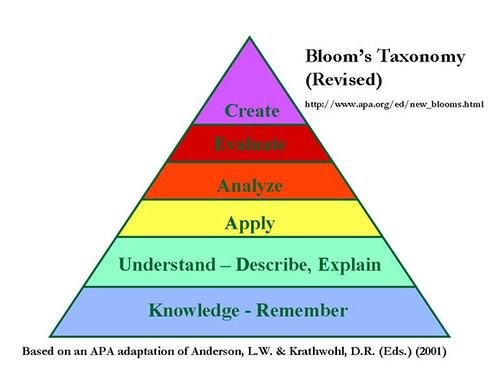
The Tutor and Bloom's Taxonomy

Today, we published our first article at www.ezine.com! You can read the full text here.


Some tutors focus on surface level understanding in order to achieve quick results. This strategy is a symptom of the standardized testing age and does little to encourage long term success in our children. As we develop our own deeper understanding of education, we have come to learn that spending hours on rote memorization and evaluating progress by having a student state a one word answer is not enough. For this reason, a great tutor will balance time between memorizing new facts and developing higher ordered thinking skills.

Lower ordered thinking skills are associated with memorization and regurgitation. A student who excels on multiple choice and fill in the blank tests is demonstrating, more often than not, merely a surface level understanding of material. High ordered thinking skills involve application and analysis of information. Students that complete projects, solve real-world problems and make artwork are demonstrating a deep understanding of the material being studied.

Published in 1956, Bloom's Taxonomy of the Cognitive Domain listed, in order, six levels of understanding, or "learning domains", from simple to complex.

1.Knowledge
2.Comprehension
3.Application
4.Analysis
5.Synthesis
6.Evaluation


The good news is that gaining a deeper understanding is usually more fun than simply memorizing material. The bad news, for schools at least, is that developing higher ordered thinking skills takes a long time. Students need time to play, to make mistakes and new discoveries. They need time to experiment, to meet mentors, and to make big messes that take a long time to clean up. To the public school teacher, who may have students that various abilities, emotions and social skills, developing higher ordered thinking skills is risky business.

A few hours with the right tutor each week will give your child the best opportunity to develop higher ordered thinking skills. A good tutor will spend time on the area of focus, such as fractions or reading, in order to achieve success quickly. (After all, that's why you are paying a tutor). A great tutor will go one step further and continually call back on skills that the student has demonstrated proficiency, in order to develop more valuable skills such as application, analysis, synthesis and evaluation. Aside from the search bar on Google, there are not too many opportunities in the 21st century that are simply "fill in the blank".

Wesley Davis is a tutor for Limelight Education in San Diego, California. Limelight Education offers in-home tutoring in San Diego County and online tutoring around the globe. Their web address ishttp://www.limelighteducation.com

Article Source: http://EzineArticles.com/?expert=Wesley_B_Davis


http://ezinearticles.com/?The-Tutor-and-Blooms-Taxonomy&id=4095976

Sunday, April 11, 2010

San Diego STAR Test Tutor

Limelight Education has experienced a recent boom in business thanks to California STAR testing. Our philosophy is to work towards a deep understanding of the basics of math while focusing on standardized test taking strategies. We have helped students in elementary, middle and high school increase their STAR test scores.

Here are some released test questions for the 5th grade California STAR test in math.
http://www.cde.ca.gov/ta/tg/sr/documents/rtqgr5math.pdf

Just search google with "STAR test RTQ" followed by the grade and subject and you will find a plethora of multiple choice questions to get the ball rolling.

Give me a call at (888) 50 TUTOR to discuss in-home or online tutoring.

San Diego Math Tutor

Wednesday, July 8, 2009

The Tony Hawk Foudation: Grant Money for Skate Parks

As taken from their website, the Tony Hawk Foundation's mission is to

"..foster lasting improvements in society, with an emphasis on supporting and empowering youth. Through special events, grants, and technical assistance, the Foundation supports recreational programs with a focus on the creation of public skateboard parks in low-income communities. The Foundation favors programs that clearly demonstrate that funds received will produce tangible, ongoing, positive results. "

The foundation offers grants for skateboard park programs. On their website they stress that the requests for grant money, which max out at 25,000 dollars, far outweigh the funds available. Teachers or students interested in building a skate park in a low-income neighborhood should read through the grant application information. Your school could be the perfect place to organize grass roots support for a new skateboard park. Maybe Tony will name it after you!


This blog is maintained by Limelight Education LLC. Email us at network@limelighteducation.com