
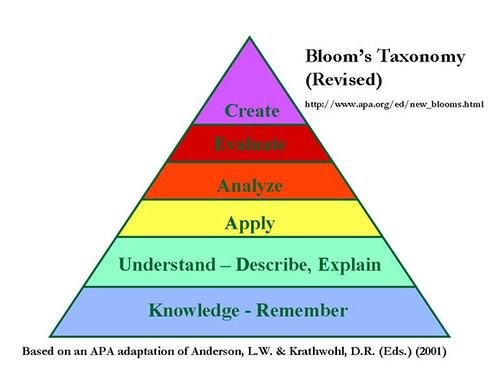
Some tutors focus on surface level understanding in order to achieve quick results. This strategy is a symptom of the standardized testing age and does little to encourage long term success in our children. As we develop our own deeper understanding of education, we have come to learn that spending hours on rote memorization and evaluating progress by having a student state a one word answer is not enough. For this reason, a great tutor will balance time between memorizing new facts and developing higher ordered thinking skills.
Lower ordered thinking skills are associated with memorization and regurgitation. A student who excels on multiple choice and fill in the blank tests is demonstrating, more often than not, merely a surface level understanding of material. High ordered thinking skills involve application and analysis of information. Students that complete projects, solve real-world problems and make artwork are demonstrating a deep understanding of the material being studied.
Published in 1956, Bloom's Taxonomy of the Cognitive Domain listed, in order, six levels of understanding, or "learning domains", from simple to complex.
1.Knowledge
2.Comprehension
3.Application
4.Analysis
5.Synthesis
6.Evaluation
The good news is that gaining a deeper understanding is usually more fun than simply memorizing material. The bad news, for schools at least, is that developing higher ordered thinking skills takes a long time. Students need time to play, to make mistakes and new discoveries. They need time to experiment, to meet mentors, and to make big messes that take a long time to clean up. To the public school teacher, who may have students that various abilities, emotions and social skills, developing higher ordered thinking skills is risky business.
A few hours with the right tutor each week will give your child the best opportunity to develop higher ordered thinking skills. A good tutor will spend time on the area of focus, such as fractions or reading, in order to achieve success quickly. (After all, that's why you are paying a tutor). A great tutor will go one step further and continually call back on skills that the student has demonstrated proficiency, in order to develop more valuable skills such as application, analysis, synthesis and evaluation. Aside from the search bar on Google, there are not too many opportunities in the 21st century that are simply "fill in the blank".
Wesley Davis is a tutor for Limelight Education in San Diego, California. Limelight Education offers in-home tutoring in San Diego County and online tutoring around the globe. Their web address ishttp://www.limelighteducation.com Article Source: http://EzineArticles.com/?expert=Wesley_B_Davis |


No comments:
Post a Comment